Auditions and the Night I Almost Left
There's a peculiar kind of dread when you walk into a room full of strangers who all know everyone but you. How do we fight the Interloper Demon?



It was a dark and stormy night. Well, possibly. In fact, I can't remember the weather or whether the sun was still in the sky, but I do remember how arriving at the hall made me feel: both scared of the dark and desperate to seek shelter from the storm.
Our brains always work terribly hard to undermine us before we even get in the room. And as actors, there's no more destructive time to be undermined than at your first audition with a new company. However many years you've been doing it, that feeling of being an outsider at an audition is enough to gnaw at the confidence of even the cockiest actor. And if you've been working with a single drama group for years, the change can be quite discombobulating. How do they run their auditions? How formal or jovial do you need to be? How imaginative should you be with your audition piece? Are you going to look like you're trying too hard?
A hall full of strangers
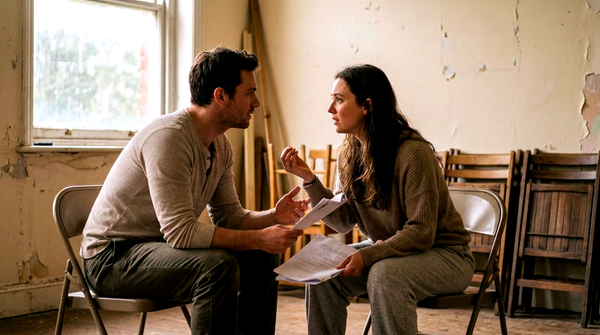
Anyway, back to the story. It was 2012 (I had to look that up; I can't believe it was so long ago) and I'd had a new theatre group recommended to me for their upcoming summer production of Macbeth. But in the room there was nobody I knew. They hadn't given out audition pieces or character breakdowns in advance, presuming, I suppose, that everyone must know about the play already. But turning up to a hall full of strangers not knowing which of the 17,000 words I'd be expected to perform was frankly a little bewildering. But that wasn't the worst of it, oh no. Already socially and creatively nervous as I took a seat around the edges of the hall (not next to anyone else, I mean that would be weird, wouldn't it?), I realised with rapidly ascending panic that these auditions were being held in front of everybody. There was a panel of, I think, three people, but they paled into insignificance compared to the swathes of prospective actors circling the audition space.
Back then I'd already directed a good few times, but my previous group had a rather casual way of auditioning for their shows. Anyone interested would turn up, we'd all sit in a big circle in the hall and read through the play, swapping readers for the different characters every few pages. Now I've always been lucky that I can sight read fairly easily. Give me a page of script and, while I might not know much about the play as a whole, I can generally put on enough of a character, enough of a voice to make it an entertaining listen. This, of course, is nothing like acting and a pretty terrible way to hold auditions, but more on that later. But this, sitting in the Macbeth auditions, suddenly very conscious of how I was sitting and whether I was smiling enough or too much, I felt completely out of my depth. The trouble was primarily that everybody else seemed to know each other. There was chat and gossip and in-joking and back slapping. There was, as in any group of humans, a tribe, and I wasn't a part of it. I wanted to leave. It was clearly just a mistake. This was a gathering of friends who'd decide which of them should do the roles in the play, while the strangers were just to add a sense of fairness to the proceedings. I wanted to leave and retreat to where I was safe, where I knew how things worked, where people already knew what I could do on a stage.
I'm very glad I didn't.
The stories we tell ourselves
The problem is, we all tell ourselves these stories in advance, trying to figure out the precise flavour of our failure so that we're not surprised by it when it inevitably happens. After all, to fail is shameful enough, but to actually have thought you might succeed is just humiliating. And so we weave these tales for ourselves and we carry them into the audition room. Don't look like you're trying too hard, don't look like you think you actually have a shot, here. This leads to what directors will recognise as the 'chronic apologiser'. "Hi, sorry, did you want me next? Sorry, I'm Brenda, did you want me to read for Lady McMuffin, or...? I really don't mind, whatever you want. Sorry. Oh, can I just start again? Sorry, sorry, sorry." It's a much stronger start to walk into your audition, say "Hi, I'm Brenda, reading for Lady McMuffin," take a breath and then just get on with it, but that can feel impossible when you're gasping for breath in the swimming pool of nerves.
What's really happening on the other side of the table
Of course, every last bit of this is born out of not understanding what's actually happening on the other side of the table. For directors, casting is a nervewracking process. At that precise moment, they have a million wonderful ideas for their show in their head, and they simply don't know if they'll get the cast to pull it off. Even if a thousand people are lining up around the block to audition, finding not only the right people but the right combination of people who work well together, is rare and precarious. All of this comes down to a simple truth: when you walk into the audition space, the people on the panel want you to succeed. They want you to be surprising and spectacular. They want you to be the fuel that turbocharges their show.
Preparation beats experience
So how can you be the hero the show needs? Well, I've found it comes down less to experience and more to preparation. As I said, being able to read out a script in a way that sounds like a performance rather than a GCSE English lesson is a benefit, but it won't make you stand out in a crowd of budding performers. Most companies don't ask for a CV of acting roles before you audition, so the benefit of any experience has to be shown on stage. And that comes from preparing properly.
These things will sound, as I say them, to be so blindingly obvious it's almost laughable, but the vast majority of people simply do not do them. Their auditions become an exercise in sight reading which, as previously discussed, is not the same as acting. For a start, get to know the play. Ideally, get a copy and read through the whole thing, but reading a summary and even reviews of other productions can help. This is the only way to put your audition performance in context, and to do the single most important thing when auditioning: show you've put some thought into it. This is where a director will see the gap between the sight readers and the actual actors. Actors will have made the effort to understand the character they're reading for and made some decisions about how to perform. Is your character afraid of losing something precious to them? Are they insecure, or engulfed in rage, or overwhelmed by sadness? And why? These decisions will help you fill in the spaces between your lines, which is where all the most interesting acting happens.
Now, these decisions aren't a test. They don't have to be 'right'. Final performances come out of the whole messy, organic process of rehearsal, so don't worry about trying to guess what the director's imagining for the part. Showing that you've put effort and thought into your part is step one. Step two is to show that you're adaptable. Most directors worth their salt will give you some direction during your audition, whether they ask you to redo a piece in a different way, or pairing you with a different person to see how that changes things. You don't ever have to think that this is in any way a criticism of how you did it first. This is a test of how easy you are to work with. If you've played the part full of rage and bile and the director asks you to do it again sad to the point of tears, that's not a judgement of your first performance, it's an opportunity to show even more of your range.
Reading the script like music
These days, I tend to cheat at auditions. I don't mean I slip the director a tenner or poison the competition, but I take my memory out of the equation. I know it turns to fluff under pressure, so while I'm preparing my audition piece, I'll decide how I want to deliver the lines and mark up the script with little pencil marks showing pauses, run-ons, changes in pace and intensity, or mood. You usually don't have to memorise an audition piece (and certainly don't try to unless you've been asked), so having these marks on the script lets you read it like music. The rise and fall, the hanging pause, the rolling crescendo. I've always found that this doesn't just improve my audition performance, but reduces the stress of it too. It gets me out of that infuriating double think on stage, when I start second guessing my delivery before the words are even fully out of my mouth.
When you fumble
You will fumble. This happens to everyone at some point. Your tongue will take the beautiful flowing prose of the playwright and turn it to gubbins when you try to say it on stage. This is another time to avoid over-apologising. Stopping, sorry-ing and starting again is derailing for you and jarring for the people watching. I've always found it more powerful to keep in character and do that bit of the line again. If your character is in a state of high emotion, you can hide a fumble perfectly well in the anger or agitation or agony they're feeling. Even if they're not, you can usually drop in a teeny huff of their frustration and do those few words again. Don't go back too far, just enough to make yourself clear. For a director watching, that will show valuable stage confidence which is actually much more important than being word perfect. Live theatre is a living creature that delights in throwing us off, like those mechanical bulls they have in bars in American films. Show you can keep your seat amidst all the bucking, and you'll show just how valuable you are to the show.
A cautionary tale: the dame who did a runner
I want to share a tale of a tit-up with you. It isn't from an audition, but it is most certainly about fumbling. Back in the late 1400s when I was a teenager, I was in a community pantomime that, unless memory has jumbled these things up, had been penned by me and my friend Alex. Now, the auditions had turned up a new man to play the dame. He had a great voice for it at the readings and a cheeky onstage demeanour that brought a lot of fun to the role. And, after all, what does a panto dame need more than a sense of fun? Now, the precise nature of the plot eludes me, but it was basically that the evil queen had kidnapped Santa's daughter when she was a baby and now, sixteen years later they were going to rescue her. Quite why there was a sixteen year delay I'm not sure, but such is the nature of panto. Now our dame, in full swing in the second half, suddenly found himself starting to wobble. Just a bit, at first: a little hesitation finding the lines here and there, having to be led on stage for his entrances when he was meant to be first out, that sort of thing. Nothing, at first, anything the audience would have noticed, but as fellow actors in the wings who'd gone through the show so many times, we could definitely pick up the whiff that something was amiss. And then, the thing happened: we started to realise that the lines coming out weren't the usual ones. Now panto always wanders to and fro over the script, but there's a very distinct sound to the lines when the show's going off the road, a sort of looping, tremulous wobble as the actors aren't just trying to reach for a half-remembered line but are completely lost as to where they are in the script. Now, and this is the point I've been weaving towards: an actor finding themselves onstage in this situation has precisely two choices. One is right, and one is catastrophic. Our dame did not choose wisely. The lead character on the stage, the scene circling the plug hole, the dame quite simply did a runner. The others on the stage at the time, being teenagers with little stage experience, followed him. The stage was left empty and silent, fully lit and painfully and obviously wrong. Our dame could not be persuaded back on to the stage, even after our previously unflappable stage manager had shown him his place in the script. The show, as they say, must go on, and my dear friend Alex, all of sixteen precocious years old, stepped on stage in his tiny cameo role as the Prime Minister from earlier in the show.
"Well something's clearly gone wrong," he declared in his pompous character voice, before artfully improvising for enough time to steady our flapping dame in the wings, allowing us to restart the scene. Alex exited the stage after looking around at the set and saying, "Why am I in the North Pole?"
Trusted and untrusted
Why am I telling you this? I was talking about auditions. Well, many directors will tell you, though possibly only in secret, that there are two types of actor you see come through to auditions. They are trusted, or they are untrusted. This isn't to do with knowing the actor from previous shows, it's 'trusted' in the sense of being able to keep control of live theatre. Our hapless dame was notably unable to do that. So if you fluff a line in your audition piece and can still keep the scene going, that is a hugely positive signal to a director that you can be 'trusted'. And that is tremendously valuable.
Keep showing up
And above all of this, if you find yourself trembling in the wings before your audition, suddenly in need of a wee, remember that everyone there, every single luvvie-coded one of us, was a newcomer once, too. Everyone will have had shows they weren't cast in, roles they weren't quite right for, and auditions they feel they spent tripping over themselves and being terrible. The ones who are still there are the ones who kept showing up. So keep showing up. Take all the opportunities that come your way: all the auditions, all the chorus roles, all the chances to help backstage with shows you didn't get cast in. Building that experience and building those connections is the way into bigger, better things. And, of course, shows are fun, whatever role you end up taking. We're amateurs, we don't do all this to pay the bills, we do it for the love of it (which is, of course, where the word 'amateur' comes from).
So keep showing up. Untold theatrical wonders await.
For Stage Whispers members, we've got a little more for you after the break: two memorable audition stories from both sides of the table that I still think about today, and an audition prep technique I was taught years ago that I still swear by; I'll take you through how to use it.
If you'd like to join us as a Stage Whispers member, starting with our Free Forever tier, you can do it at stagewhispers.co.uk.
For the rest of you, thank you so much for listening.
See you next time.