The £47 Set
Why suggestion beats reproduction, and light does the heavy lifting.
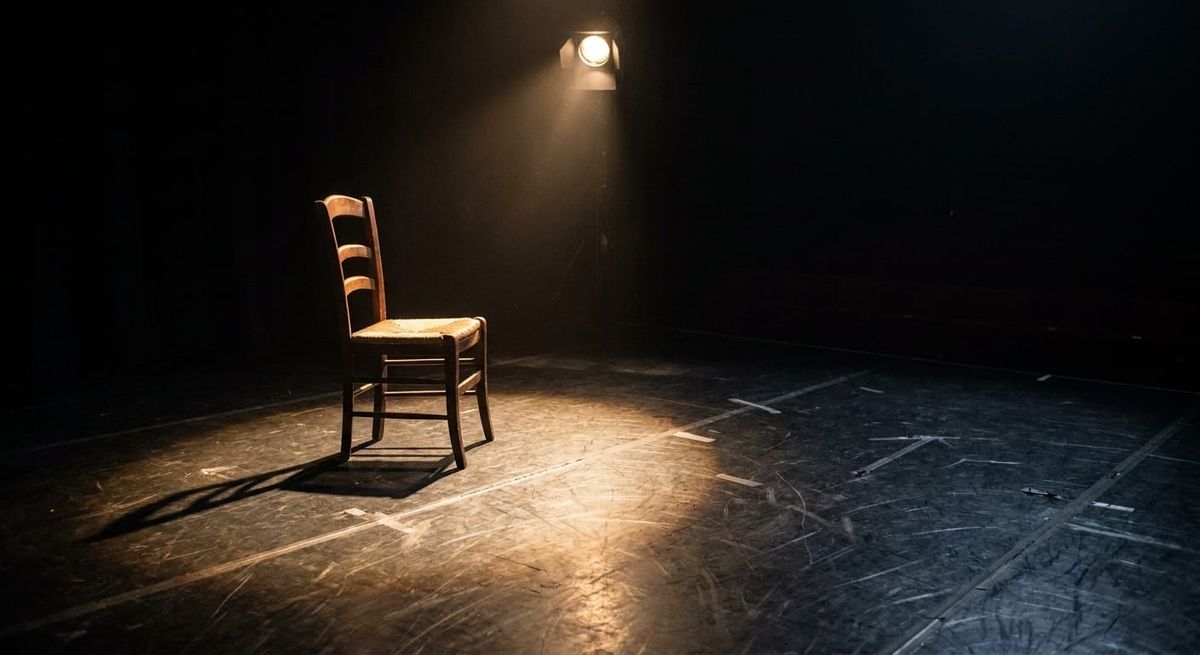
Here's the brief every small theatre actually works to: build a convincing world, and here's forty-seven pounds to do it with.
Walk into the workshop of any small theatre and you'll find the same conversation happening, usually at about eleven o'clock at night with three weeks to go. We can't afford the set. We never can. The design in everyone's head needs money we simply don't have, and so the temptation is either to scale back the ambition or quietly remortgage the lighting budget to build the thing anyway.
There's a third way, and it's the one that almost always makes for better theatre. Stop trying to build the world, and start trying to suggest it.
An audience is not a passive thing sitting in the dark waiting to be shown everything. An audience is desperate to do some of the work. Give them a doorframe and a pool of light and they'll build the rest of the house themselves, and they'll build it better than you ever could, because they'll build it out of their own imagination. A single chair, placed right and lit right, can be a throne, a confessional, or a deathbed. Three crates and a length of rope can be a ship. We know this. We've all sat in audiences and gladly believed it.
This is the great liberation of a tiny budget. It forces you towards suggestion, and suggestion is more theatrical than reproduction. The most expensive, fully realised box set is often the least interesting thing you can put on a stage, because it leaves the audience nothing to do but admire the joinery.
So before you cost up a single sheet of ply, ask what the scene actually needs. Not what the room looks like in real life, but what the story needs the audience to feel. A kitchen-sink drama might need nothing more than a table, two chairs and the right slant of light through an imagined window. The rest is in the writing and the playing.
And lean on light. Light is the cheapest scenery you own, and the most powerful. A change of state, a shift of mood, the difference between morning and dread, all of it can be done with what's already in your rig and a bit of thought. Repainting a wall costs money and a weekend. Relighting it costs nothing and takes ten minutes.
A few good rules to carry into the workshop. Build less, but build it well, because a wobbly flat that's meant to be solid will pull an audience straight out of the moment. Use texture and real materials where the audience can see them up close, and cheat everything they can't. Borrow before you buy, and beg before you borrow. And keep asking the only question that matters: does this earn its place, or is it just here because the script happened to mention a sideboard.
None of this is about making do, though it can feel like it at midnight in the workshop. It's about a genuine truth of the form. Theatre has always been about a few people agreeing to pretend together in a room. The set's job isn't to remove the pretending. It's to give it just enough to lean on.